
DIAGNOSTICS — HC-VCI
Bluetooth diagnostic interface for VP30 and VP44 pumps
Reads and drives the electronics of a Bosch VP30 or VP44 pump from an Android phone or tablet, over Bluetooth — on the bench or on the vehicle.
Wires in-line into the pump harness on native PSG5 connectors. No OBD socket, no adapter, no account, no subscription, and no internet connection.
The Android app is free. No account, no internet permission.

Google Play and the Google Play logo are trademarks of Google LLC.
What it is
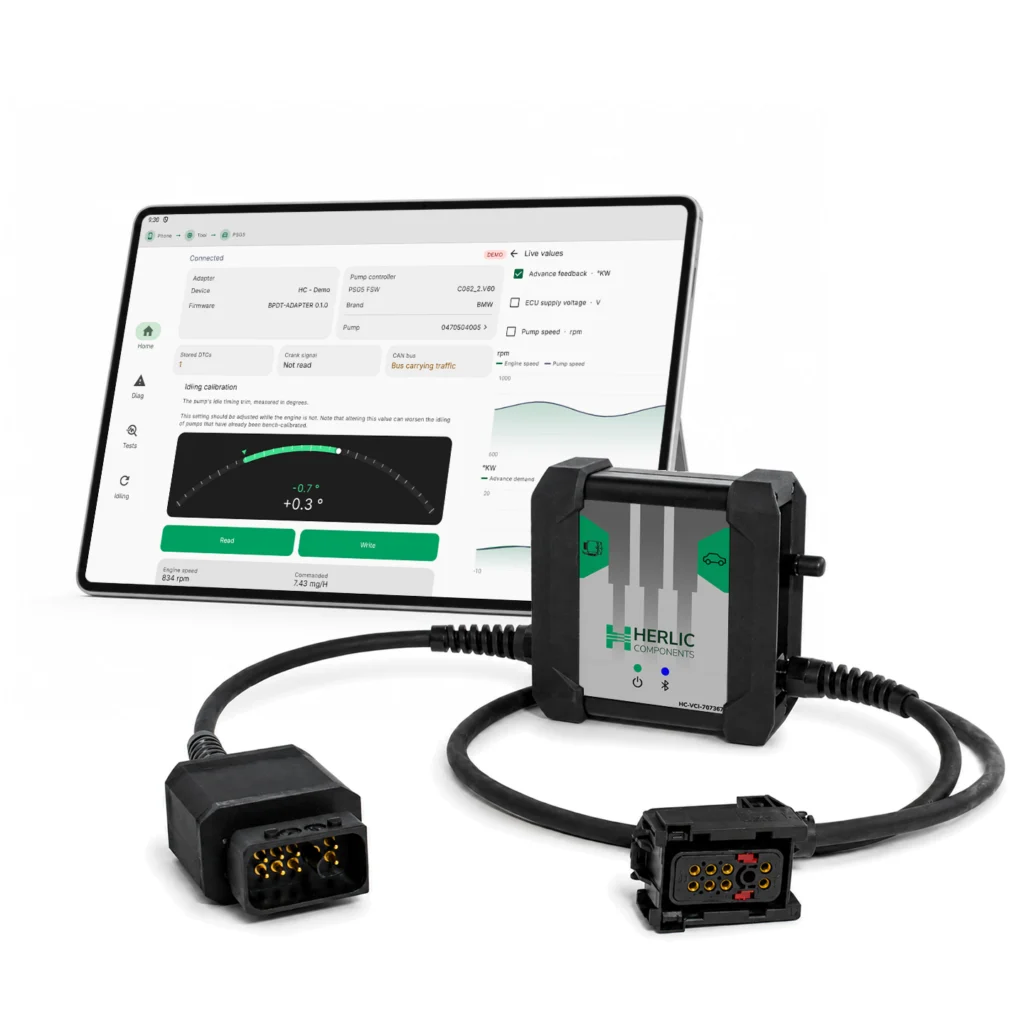
HC-VCI is a vehicle communication interface for Bosch VP30 and VP44 distributor injection pumps fitted with PSG5 electronics. It links an Android phone or tablet to the pump over Bluetooth, works on the bench and on the vehicle, and runs entirely offline.
What separates it from a fault-code reader is where it sits. The interface wires in-line into the pump harness, so it measures the crank signal, the shut-off line and the injector drive current itself, at the same time as it reads what the control unit makes of them. When those two disagree, the tool says so.
That is the difference between “there is a crank fault” and “the sensor is fine, the control unit is not reading it” — and it is the answer that decides whether a unit is worth stripping.
What it does
Every operation the v1 tool performs, in plain terms.
Identification
- Identify the unit. Reads the Bosch part number out of the control unit and names the pump — series, cylinder count, marque — so the technician confirms what is in front of them before touching it.
- Control-unit software version. The pump’s own firmware string, for records and for matching against a repair history.
Faults
- Read stored fault codes. Decoded to plain text, read automatically the moment the tool connects.
- Clear stored fault codes. After a repair, as a deliberate confirmed action.
- Read live pump status. What the control unit is reporting right now, decoded and graded by severity. Shown beside the stored codes and never substituted for them: a stored code with nothing currently reported means the fault has cleared, and a condition reported with no stored code means the control unit has not logged it.
Adjustment
- Idle adjustment. Reads the idle calibration value stored in the control unit and writes a new one, on a dial. Reversible — the original value is readable and can be written back at any time.
Live measurement
- Live data. Engine speed, injection timing, commanded fuel quantity and a selectable set of further channels, updated continuously, with a graph view.
- Supply voltage. The voltage on the rail the pump is running from, measured by the interface itself rather than asked for over the diagnostic line.
- CAN bus health. Whether the pump’s bus is alive, quiet or in error, with the error counters behind it.
Checks on its own signals
- Crank-signal check. Measured on the interface’s own input, so it reports the sensor and its wiring independently of what the control unit says about them. It works with the pump unpowered — the one check still available when nothing else is.
- Injector drive-current check. Measures the peak-and-hold current in the solenoid drive and reports whether both phases are present, which is how a failing drive stage shows itself before it stops the engine.
- Shut-off line test. Watches the shut-off line, then reports whether the control unit reacted to it and how long it took.
- Cranking test. Runs the checks above together during a crank and reports, in three rows, where the chain breaks: are both speed signals present, is anything commanding fuel, and is the injector actually being driven. It reaches a verdict even with the crank sensor disconnected, which is the case it exists for.
- Diagnostic-line check. States whether the K-Line to the control unit is working, and after three consecutive failures says so as a conclusion rather than leaving the technician to count attempts.
Immobilizer
- Read immobilizer state. Whether the control unit is locked, and whether it is paired to a vehicle, reported at rest without running anything.
- Immobilizer watchdog check. Verifies the watchdog signal an immobilizer pump emits, and reports its shape rather than a bare pass.
- Unlock a Ford control unit. Unlocks and virginizes a locked Ford PSG5 control unit so the pump can go to a different vehicle. Measured end to end at 4.1 seconds. All Ford PSG5 pumps are covered.
What it cannot do
Stated plainly, so nobody buys it for a job it does not do.
- It is not an OBD-II scan tool. It wires in-line into the pump harness, not into the vehicle’s diagnostic socket, and it reads nothing outside the pump electronics. No engine codes, no other control units.
- Bosch VP30 and VP44 with PSG5 electronics only. No common rail, no other pump family, no other control-unit generation.
- It runs on Android. There is no iOS app and no PC software.
- It does not code, program or replace a control unit, and it does not write the Audi immobilizer PIN.
- Idle calibration is manual. The tool gives the technician the value and the dial; it does not run a calibration procedure by itself, and it does not run the pump.
- It needs a working diagnostic line to identify a pump. On a unit whose K-Line is dead the pump cannot be identified, and the checks that depend on knowing which pump it is are unavailable. The signal checks above still work.
- It does not judge mechanical condition. It reads and drives the electronics. A bench is still a bench.
Compatibility
HC-VCI is built for one family of pump electronics. It is not a general-purpose scan tool, and it does not try to be.
- Bosch VP30 and VP44 distributor injection pumps fitted with PSG5 electronics
- PSG5 only — not PSG16, and not earlier PSG generations
- 110 pump part numbers held in the tool, reachable through 147 identifiers once exchange and Zexel numbers are counted
- Ford PSG5 control units — unlocking covered across the range
- Bench and vehicle alike
Connection is in-line into the pump harness on native PSG5 connectors — male on one side, female on the other, 40 cm of cable each side. It plugs between the existing vehicle-side and pump-side connectors. Nothing is cut, spliced or adapted, and no extra loom is needed.
What you need to run it
- An Android phone or tablet, 7.0 or newer. The app lays out for both and uses a two-pane layout on a tablet. Classic Bluetooth required.
- The app is free, with no account, no login, no registration and no subscription.
- No internet connection. The app holds no internet permission at all — it physically cannot reach a network. Everything works offline, permanently, including in a basement workshop with no signal.
- English, Spanish and German.
- No separate power supply. The interface runs from the pump or vehicle harness. Nothing to charge.
- Working range up to 50 m in the open. What decides it is how much bodywork sits between the interface and the tablet, so an open bench gives the upper end and a closed body markedly less.
What you get
- The HC-VCI interface, with its PSG5 connectors and cables fitted — 40 cm each side
- Two spare fuses
Nothing is sold separately. The connectors are native PSG5, so no adapter, loom or extra cable is needed for any supported pump.
The interface is fused against overcurrent and the fuse is replaceable in the workshop — that is what the two spares are for. A blown fuse on a mis-wired bench is a two-minute job, not a return.
How it works
- Unplug the pump connector and plug HC-VCI in between — vehicle side to one end, pump side to the other. Nothing is cut or adapted.
- The interface powers up from the harness. Pair it with the phone or tablet over Bluetooth.
- The tool identifies the pump and reads the stored fault codes as it connects.
- Diagnose, run the cranking test, adjust the stored idle calibration, or unlock a Ford control unit.
An HC-VCI session on a VP44 pump: wiring in, identification and idle adjustment (0:35).
Specifications
The HC-VCI interface and its Android app, as they ship.
| Coverage | |
|---|---|
| Supported pumps | Bosch VP30 / VP44 with PSG5 electronics. PSG5 only — not PSG16, not earlier PSG generations. |
| References held | 110 pump part numbers, reachable through 147 identifiers once exchange and Zexel numbers are counted |
| Immobilizer unlock | All Ford PSG5 control units. 4.1 s, measured end to end. |
| Connection | |
| To the pump | In-line into the pump harness on native PSG5 connectors, 40 cm of cable each side. Not an OBD plug-in; no adapter or extra loom. |
| To the phone or tablet | Classic Bluetooth. Up to 50 m in the open; less through a vehicle body. |
| Protocols | CAN-BUS and ISO K-LINE to the control unit |
| Measurement | |
| Measured by the interface | Crank signal, shut-off line, injector drive current, supply voltage |
| Read from the control unit | Identity and software version, stored fault codes, live pump status, live data, CAN bus health, immobilizer state |
| App | |
| Platform | Android 7.0 or newer, phone or tablet. No iOS, no PC software. |
| Languages | English, Spanish, German |
| Internet | Not required and not requested — the app holds no internet permission |
| Account | None. No login, no registration, no subscription. |
| Electrical and physical | |
| Supply | 5.5 to 32 V DC. 12 V and 24 V systems both supported. |
| Power source | From the pump or vehicle harness. No separate supply. |
| Protection | Fused against overcurrent. Fuse replaceable in the workshop; two spares supplied. |
| Operating temperature | −30 °C to +70 °C |
| Dimensions | 13 × 13 × 5 cm, plus 40 cm of cable on each side |
Support
- Technical support by email and telephone, direct to Herlic Components.
- App updates are free for as long as the product is supported. There is no subscription, and the tool keeps working without them.
- Lead time one week, plus standard shipping from Spain to the destination country.
- Engineered in Europe.
Add HC-VCI to your workshop.
Request pricing and availability, or find your nearest distributor.